

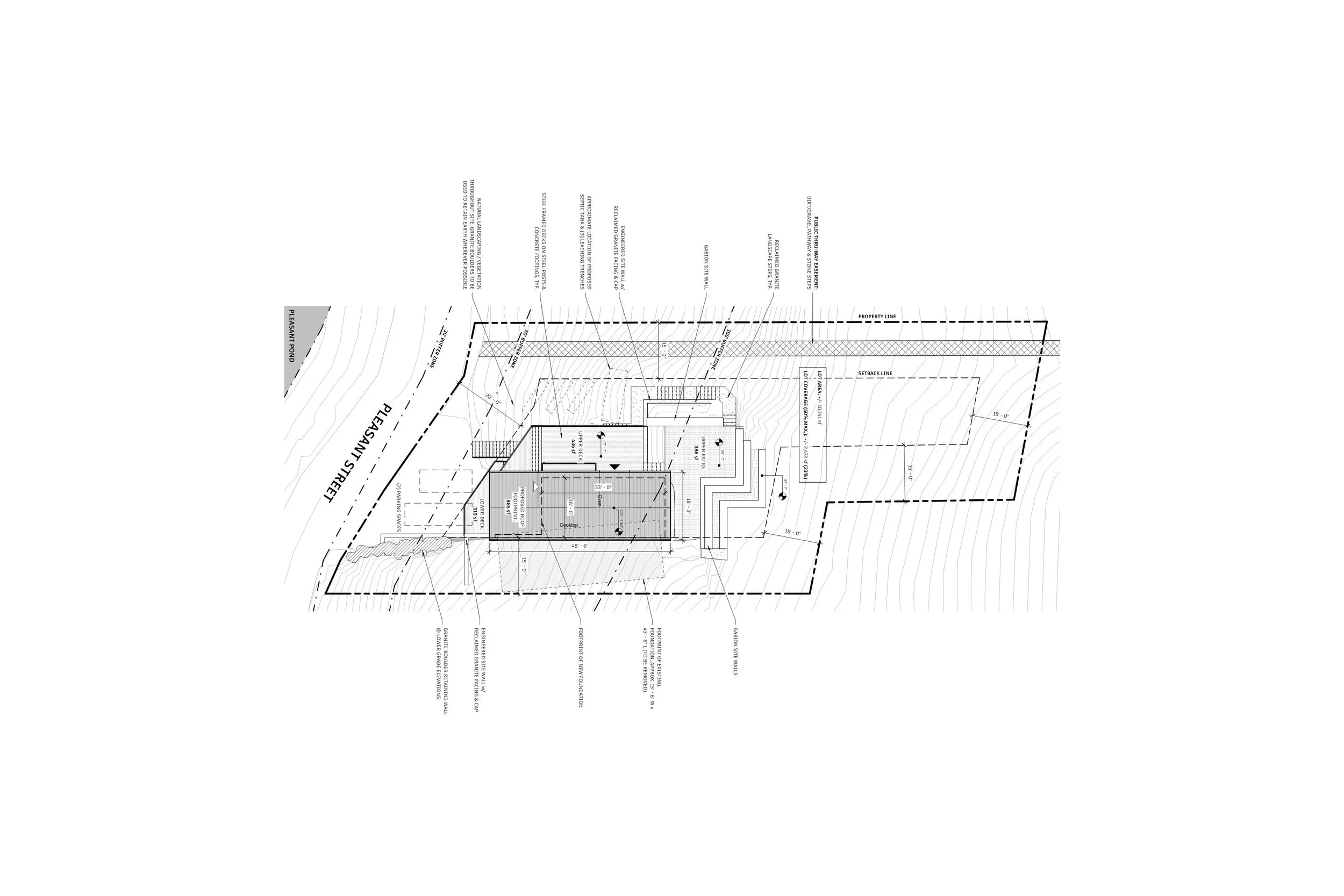
Zoning & Building Code Overview
Two of the biggest regulations & limitations you will face over the course of your project are Zoning Bylaws/Ordinances and Building Codes. When it comes to obtaining approval for your project, the Authority Having Jurisdiction (AHJ) has the ultimate say in whether or not your project meets the necessary requirements. AHJ typically refers to the Building Inspector or Commissioner in your town or city.
Depending on the scope of your project, you may be looking at needing to receive approval from various commissions or boards prior to receiving a building permit. This can include: Zoning Board of Appeals, Planning & Development, Conservation Commission, or Historic Commission.
Before we even think about designing, we spend the time fully understanding the zoning requirements for your project’s zoning district, and the building codes that apply to the building type in order to gauge the project’s feasibility and limitations.
Zoning Laws/Ordinances
Zoning regulations are established to provide clear and consistent direction when constructing a new building or renovating/adding onto an existing building. Generally, they dictate the overall size that a property can be and where on that property you are allowed to build.
These regulations can vary across different jurisdictions (towns or cities) and across various zoning districts within a city or town, but for the most part follow the same basic principles:
Overall Lot Size: minimum area a lot can be
Frontage: minimum width of your property along the front property line
Setbacks: the minimum distance from the property line that a building must be
Lot Coverage/FAR: the maximum area of the property that the structure can cover, typically expressed as a percentage. FAR refers to “Floor-Area-Ratio”, this is another method of regulating the overall size of the building and equals the sum of all floor areas of the structure divided by the total lot area.
Open Space: in addition to lot coverage, some jurisdictions may require that the property maintain a minimum open area free from permanent structures, roof overhangs/covered porches or patios, or even hardscaped surfaces like impervious patios or driveways.
Accessory Structures: in most cases, detached accessory structures (garages or sheds) or attached decks or porches are permitted to extend beyond the minimum required setbacks provided they meet supplemental dimensional standards (typically in the form of a height or area limitation, or a reduced setback).
When starting a new construction or addition project, it is a requirement to produce an existing and proposed survey/plot plan from a Professional Land Surveyor in order to demonstrate to the AHJ that the zoning requirements are being met.
Additional Requirements & Approvals
In addition to the basic zoning principles described above, there may be several other dimensional factors or even more specific design guidelines that your project will need to follow in order to receive approval. All of which will be determined upon our initial review of the project.
Depending on the specific conditions of the property and existing structure(s), if any, you may be required to receive approval from a local board or commission:
Zoning Board of Appeals (ZBA)
Should your project fail to meet even one of the dimensional requirements for the zoning district, you will need to receive approval from the ZBA in the form of either a variance, special permit, or potentially both.
Project Timeline Impact: typically 3-4 months
Planning & Development Board (PDB)
Depending on the type and size of your project (typically in the case of multi-family, mixed-use, or commercial type projects), you may be required to initiate a thorough review process with the AHJ. This process will involve a preliminary review of the project to confirm zoning compliance and ensure adequate considerations have been made for emergency response access, snow removal, and trash collection.
It is also necessary to engage the Planning Board should you pursue the subdivision of any existing property for the sake of redevelopment.
Project Timeline Impact: typically 3-6 months +
Conservation Commission (CC)
Should your property contain protected wetlands, abut a river/stream/pond/or other body of water, or any other type of protected natural habitat, you will need to receive approval from the CC. Upon approval, you will be issued an Order of Conditions that must be followed throughout the course of construction. Typically, this process requires producing progress reports to the commission over the life of the project to ensure that these conditions are being met and properly maintained.
Project Timeline Impact: typically 3-4 months
Historic Commission (HC)
Typically in the case of a renovation and/or addition project, if the existing structure is over 100 years old or is included on a locally or federally protected historic registry, you will need to receive approval from the HC. In order to receive approval, you will need to provide detailed documentation of the proposed design (typically including specific trim profiles, window types, or other product/finish specifications). Upon approval, the HC will provide clear instructions and continual oversight to ensure that the approved design is adhered to.
Project Timeline Impact: typically 3-4 months
Non-Conforming Uses and Structures
Non-conforming refers to the condition of an existing property, structure, or building use. Particularly in Massachusetts, where we primarily work, it is not uncommon for a property or structure to be non-conforming. Some AHJs may allow your project to move forward without requiring additional approvals provided that the proposed project does not substantially increase any of the non-conformities. As soon as you are aware of any non-conforming characteristics of your project, you should engage the AHJ to inquire about how to proceed.
Non-Conforming Property: the physical boundary of the property does not meet the minimum requirements of the current zoning laws in terms of overall size, frontage, depth, or width.
Non-Conforming Structure: can refer to principal structure on the property and/or any accessory structures that do no meet the minimum dimensional requirements of the current zoning laws. This is typically in regards to things like setbacks, lot coverages, or height.
Non-Conforming Use: this refers to a situation where the use of a building is not allowed within the zoning district per the current zoning laws. This may be a commercial use within a residential zoning district, or a multi-family dwelling in a district where only single-family dwellings are permitted.
Whenever your project contains an existing non-conforming characteristic, it can be assumed that the project will require additional approval from the AHJ.
Building Codes
Building codes exist for one main purpose: to ensure the safety of the building occupants.